Shops and garages
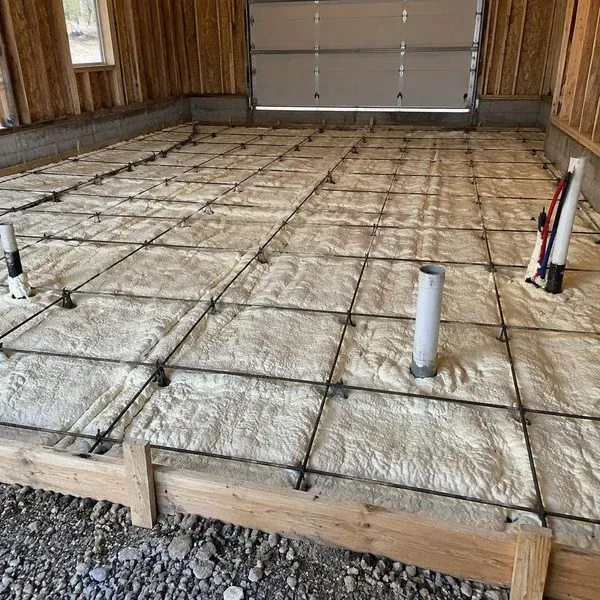
Heated shop floors are one of the most comfortable upgrades a rural property can have. The foam keeps that heat where your feet are.
For builders and owners pouring new slabs
Super Sprayers sprays high-density foam under concrete slabs for new homes, additions, shops, garages and agricultural buildings across Guelph, Wellington County and Waterloo Region. Since 2018 we have completed more than 800 spray foam jobs, and underslab work has become a bigger share every year as more owners put radiant in-floor heating into shops and basements. It is also one of the tightest timelines we work to, because the concrete truck is already booked.
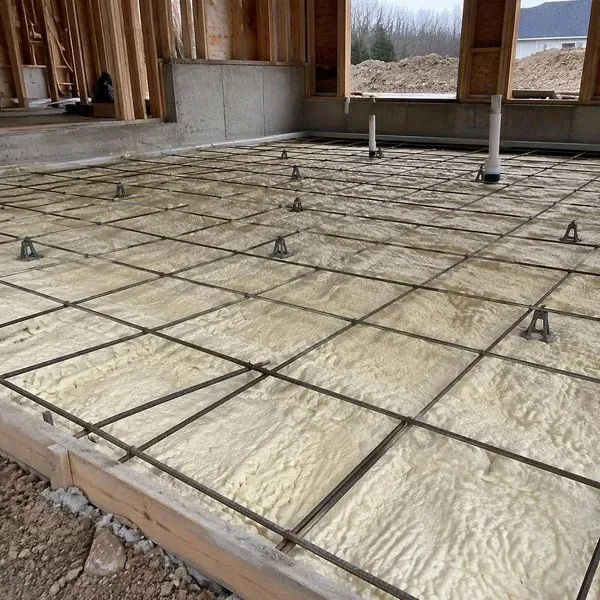
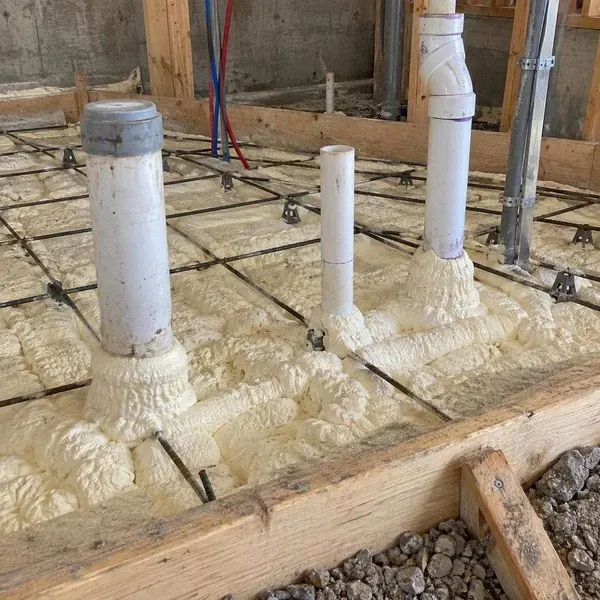
A slab on grade loses heat straight into the ground, and a heated slab loses even more because it is the warmest thing in the building. Rigid foam board is the traditional answer, but it leaves joints at every board edge and has to be cut around every pipe and drain. Spray foam goes down as one seamless layer that follows the gravel and seals tight around every penetration.
This page is written for builders, concrete contractors and owners pouring a new slab. It covers why underslab insulation matters, how spray foam compares with rigid board, the sequence on site and how much R-value you need. Our crews are CUFCA certified, WSIB covered and follow the CAN/ULC-S705 installation standard, with records you can hand to the inspector.
Soil under a building stays cool all year, so an uninsulated slab keeps pulling heat downward. In a basement or addition that means cold floors. In a heated slab it means paying to warm the ground.
With insulation below it, a radiant slab heats the room instead of the earth. The system responds faster and the boiler or heat pump runs less.
| Factor | Spray foam | Rigid foam board |
|---|---|---|
| Joints | None | Every board edge |
| Around pipes and drains | Sealed tight | Cut and gapped |
| Uneven base | Follows the surface | Needs a flat base |
| Air and moisture seal | Continuous | Only where taped |
| Load rating | High-density products rated for slabs | Rated by board type |
| Install speed | Fast on large areas | Slower with many cuts |
Underslab foam uses a higher density product than wall foam, with a published compressive strength. We confirm the product and its rating with your engineer or designer before the job.
Heated shop floors are one of the most comfortable upgrades a rural property can have. The foam keeps that heat where your feet are.
A new or replaced basement slab over foam turns a cold floor into a warm one, with or without radiant tubing.
Slab-on-grade additions and walkout levels benefit most, since the floor is right at ground level.
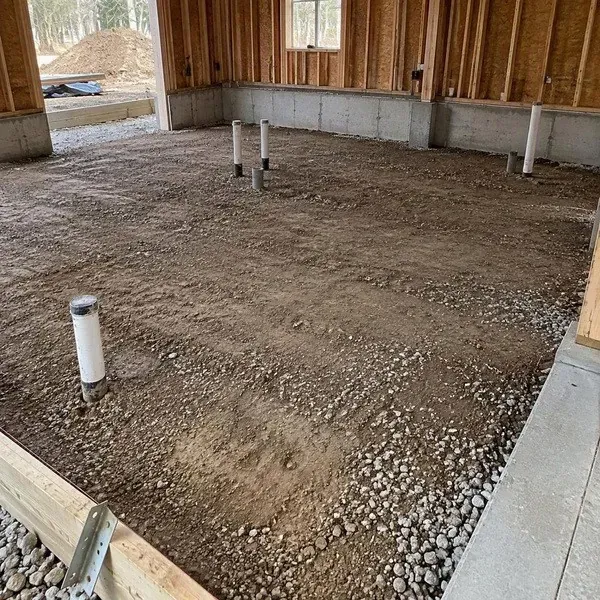
Compacted base
Gravel is placed, compacted and levelled by the excavation or concrete crew.
Plumbing rough-in
Drains and sleeves are set and inspected before foam goes down.
Spray foam
We spray the full area in lifts and seal tight around every pipe.
Vapour layer and PEX
Any required poly and the radiant tubing go down over the foam.
Pour
Concrete is placed, usually within a day or two of spraying.
Heated slabs need more insulation than unheated ones. Values below are typical; confirm against the SB-12 compliance package for your project.
| Slab type | Typical target | Approximate foam thickness |
|---|---|---|
| Unheated basement slab | R-10 | About 2 in |
| Heated slab or radiant floor | R-10 minimum | 2 in or more |
| Heated shop floor | R-10 to R-15 | 2 to 2.5 in |
Many owners go beyond the minimum on heated slabs, because the extra inch pays back quickly in a floor that runs all winter.
Yes, when a high-density product rated for underslab use is sprayed. Its compressive strength is published by the manufacturer and checked against your design.
Closed cell foam at thickness controls vapour well, but your design or local inspector may still require poly. We follow what the drawings and the inspector call for.
Yes, if the base is not frozen and is above the foam's minimum temperature. Heated enclosures or ground heaters may be needed on cold days.
Free estimate
Send the slab dimensions, your target R-value and the pour date. We'll fit the foam into your schedule.